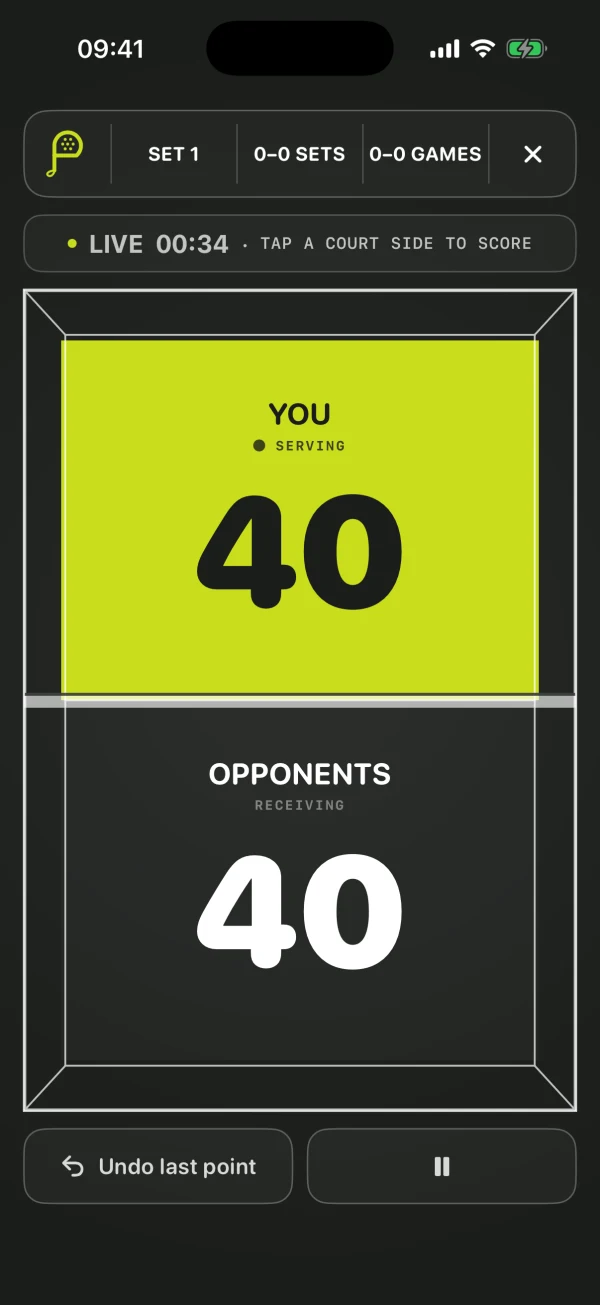
Padel scoring, in full
Padel Scoring Rules: Golden Point, Star Point & Tiebreaks
Last updated 25 September 2026
Padel borrows its numbers from tennis and then changes the endings. This is every rule that decides a padel score: the ladder to 40, what happens at 40–40, when a set turns into a tiebreak, and how a deciding set is settled.
The short version. 15 → 30 → 40 → Game — if the ending allows it. Advantage / Golden point / Star point. Under FIP rules, Star Point follows two unsuccessful advantage opportunities: at the third deuce, one deciding point wins the game. A set goes to six games, won by a margin of two. At 5–5 the set carries on: a pair now has to reach 7–5. At 6–6 the set is decided by a tiebreak instead.
| What happens at 40–40 | Called |
|---|---|
| Advantage | Classic tennis. A pair must win by two clear points. |
| Golden point | At 40–40, the next point wins the game. Agree the format before playing. |
| Star point | Under FIP rules, Star Point follows two unsuccessful advantage opportunities: at the third deuce, one deciding point wins the game. |
FIP: Star Point · 18 December 2025
Points in a game
Padel inherited the tennis ladder whole. The first point a pair wins takes them to 15, the second to 30, the third to 40, and the fourth wins the game — provided the ending below agrees. Zero is called love, and the serving pair's score is always said first, so 30–15 means the servers are ahead.
| Points won | Called |
|---|---|
| 0 | Love |
| 1 | 15 |
| 2 | 30 |
| 3 | 40 |
| 4 | Game — if the ending allows it |
Star Point example: 40–40 → advantage A → 40–40 → advantage B → 40–40 → deciding point. Either pair can win either advantage; if the advantaged pair wins the next rally, the game ends sooner.
What happens at 40–40
This is the one decision that changes how a padel match feels, and it belongs before the first serve rather than in an argument at the net. Three endings are in use.
Advantage
The tennis ending. From 40–40 a pair has to win two points in a row: the first takes them to advantage, the second takes the game. Lose the next point and the score falls back to 40–40, as many times as it takes. It rewards the stronger pair, and it makes the length of a match impossible to predict.
Golden point
At 40–40, the next point wins the game. Agree the format before playing.
Star point
Under FIP rules, Star Point follows two unsuccessful advantage opportunities: at the third deuce, one deciding point wins the game.
The current app treats its Star Point option like Golden Point. It does not implement the FIP sequence. Choose Golden Point or advantage for those formats.
Games in a set
A set goes to six games, won by a margin of two. At 5–5 the set carries on: a pair now has to reach 7–5. At 6–6 the set is decided by a tiebreak instead.
The tiebreak is played to seven points, again by a margin of two — so 7–5 takes it, while 6–6 runs on until a pair leads by two. Whoever wins the tiebreak wins the set 7–6. At 6–6 in the tiebreak, 7–6 is not enough: 8–6 wins it. In a match tiebreak, 10–9 is not enough; 11–9 wins.
Sets in a match
A padel match is one set, or the best of three. Best of three means the first pair to win two sets, so a match ends 2–0 or 2–1.
When a best-of-three match reaches one set all, the deciding set can be played out in full or replaced by a super tiebreak — first to ten points, still by a margin of two. The super tiebreak is the reason an amateur match can be booked into a ninety-minute court slot with any confidence.
Who serves, and when
Serving order matters to the score itself, because a padel score is always read from the serving pair's side.
- The serve alternates between the pairs one game at a time. Win or lose, the pair that served this game receives in the next.
- Within a pair, one player serves the whole game and their partner serves the pair's next service game — so each player serves every fourth game.
- The pairs change ends after the first game and then after every second game, which is to say whenever the total number of games played is odd.
- In a tiebreak the first server serves one point only. After that the serve changes every two points, and the pairs change ends every six points.
Padel scoring versus tennis scoring
If you already keep score in tennis, you are most of the way there. These are the differences that actually come up on court.
| Rule | Padel | Tennis |
|---|---|---|
| Points in a game | 15, 30, 40, game | 15, 30, 40, game |
| At 40–40 | Advantage / Golden point / Star point | Advantage, apart from formats that drop it |
| Games in a set | First to 6, by two | First to 6, by two |
| Deciding set | Often a super tiebreak to 10 | Usually a full set; varies by tournament |
| The serve | Underarm, after a bounce | Overarm, struck out of the air |
Americano, and other social formats
Not every session is a match between two fixed pairs. In an Americano the partners rotate: you play short rounds alongside a different partner each time, and every point you win is added to your own running total rather than to a pair's. There are no games and no sets. A round ends when a pair reaches an agreed number of points, and the player with the highest total at the end of the session wins.
Padelmatic scores Americano as a mode of its own, with the point target and how often the serve changes both chosen before you start.
Keeping score without arguing about it
Every rule above is arithmetic, and arithmetic is exactly what four people in the middle of a long rally are worst at. A change of ends, a golden point nobody agreed on, one player certain it was 30–15 — and the score becomes a negotiation instead of a fact.